Learn how to Identify Counterfeit GBP Banknotes. Also learn what to do if you find them. Also where to buy

Overview of UK Currency Design

The United Kingdom (UK) uses the Pound Sterling (£, GBP), one of the oldest currencies still in use today. Managed by the Bank of England, UK banknotes and coins have a distinctive design that reflects both British heritage and modern security standards. From the Queen’s portrait to advanced anti-counterfeiting technology, the design of UK currency is both cultural and practical.

In this post, we’ll explore the history, design elements, security features, and denominations of the UK’s banknotes and coins.


History of GBP Banknotes Design

  • The Pound Sterling dates back over 1,200 years, making it the world’s oldest currency still in circulation.

  • Early banknotes featured handwritten designs and seals, but with the 20th century, printed notes with intricate artwork became standard.

  • The Bank of England began issuing polymer banknotes in 2016 to replace paper notes, increasing durability and security.

  • Today, UK currency combines traditional symbols of national pride with modern security technologies.


Design Elements of UK Banknotes

1. Portrait of the Monarch

  • Traditionally, UK banknotes featured Queen Elizabeth II’s portrait since 1960, symbolizing national identity.

  • With the new era, King Charles III’s portrait is being introduced on UK banknotes and coins.
    See official updates at the Bank of England’s King Charles III currency page.

2. Historical Figures and Cultural Icons

Each denomination highlights notable British figures:

These choices celebrate literary, scientific, and political achievements in British history.

3. Architectural and Artistic Details

  • The notes include detailed illustrations of UK landmarks and cultural motifs.

  • Backgrounds feature patterns inspired by British heritage and identity.

4. Polymer Design

  • The UK has transitioned from paper to polymer notes.

  • Polymer banknotes are cleaner, safer, and longer-lasting than paper.

  • They are resistant to dirt, moisture, and everyday wear.


Security Features of GBP Banknotes

The Bank of England integrates world-class security features to prevent counterfeiting. These include:

  • Transparent windows with metallic holograms.

  • Color-shifting inks that change when tilted.

  • Raised print for tactile identification.

  • Micro-lettering and fine printing details.

  • Ultraviolet (UV) elements visible only under UV light.

Detailed descriptions can be found on the Bank of England: Banknote Security Features page.


UK Coin Design

UK coins also feature distinctive designs:

  • The obverse (front) traditionally displays the monarch’s portrait.

  • The reverse (back) often depicts national symbols like the Royal Shield, landmarks, or commemorative themes.

  • Since 2008, circulating coins from 1p to ÂŁ1 together form the Royal Shield of Arms when placed side by side.


Denominations in Circulation

Banknotes

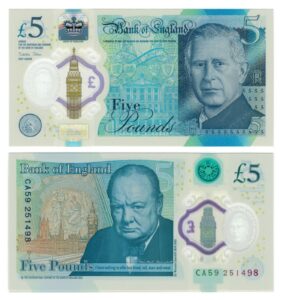
  • ÂŁ5 – Polymer, featuring Winston Churchill.

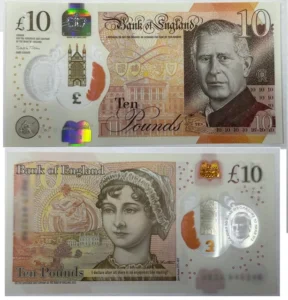
  • ÂŁ10 – Polymer, featuring Jane Austen.

  • ÂŁ20 – Polymer, featuring J.M.W. Turner.

  • ÂŁ50 – Polymer, featuring Alan Turing.

Coins

  • 1p, 2p, 5p, 10p, 20p, 50p

  • ÂŁ1 and ÂŁ2 coins

  • Special commemorative editions are often released to celebrate national events and figures.

GBP ÂŁ10 pound for sale
How to Spot Counterfeit GPB Banknotes

GBP Polymer Note Transition, Security Features, and Most Commonly Faked Denominations

The Pound Sterling (ÂŁ, GBP) is one of the most widely recognized currencies in the world. In recent years, the Bank of England has taken significant steps to modernize and strengthen the design of UK banknotes. One of the biggest changes has been the transition from paper to polymer notes, aimed at making money more durable, secure, and environmentally friendly.

In this article, we’ll look at the polymer note transition, break down the security features of each note, and highlight the most commonly faked GBP denominations.


GBP Polymer Note Transition

The move from paper (cotton-based) banknotes to polymer banknotes began in the UK in 2016, starting with the ÂŁ5 note. The transition was completed in September 2022, when the paper ÂŁ20 and ÂŁ50 notes were officially withdrawn from circulation.

Key Benefits of Polymer Notes:

  • Durability: Lasts at least 2.5 times longer than paper notes.

  • Cleaner: Resistant to dirt, water, and everyday wear.

  • Greener: More environmentally friendly as they need fewer replacements.

  • Security: Incorporates advanced anti-counterfeiting features.


Security Features of GBP Banknotes

The Bank of England’s polymer notes feature advanced, multi-layered security elements to prevent counterfeiting. Here’s a breakdown by denomination:

DenominationFeatured FigureKey Security Features
ÂŁ5Sir Winston Churchill– Transparent window with Big Ben hologram- Silver foil crown appearing above window- Raised print (“Bank of England”)- Micro-lettering visible under magnification- UV feature with number “5” glowing
ÂŁ10Jane Austen– Transparent window with Queen’s portrait- Winchester Cathedral hologram- Raised ink for tactile feel- Micro-lettering in small font- UV number “10” appears under UV light
ÂŁ20J.M.W. Turner– Two see-through windows- Silver foil patch with Turner’s portrait- Purple hologram changing between “Twenty” and “Pounds”- Raised print on words and numbers- UV “20” glows under UV light
ÂŁ50Alan Turing– Two transparent windows- Metallic hologram shifting between “Fifty” and “Pounds”- Red foil patch with 3D crown- Raised print on “Bank of England” and numerals- UV “50” appears in bright green and red

👉 Full details can be found at the Bank of England: Security Features.


Most Commonly Faked GBP Denominations

Historically, paper ÂŁ20 notes were the most counterfeited denomination in the UK. This was due to their widespread use in everyday transactions and their high enough value to make them attractive for counterfeiters.

  • ÂŁ20 (paper version): Accounted for the majority of fake notes before the polymer transition.

  • ÂŁ50 (paper version): Less common in daily use, but still a target due to its high value.

Since the polymer transition, counterfeiting rates have dropped significantly. Polymer notes are much harder to fake because of:

  • Complex transparent windows

  • Color-shifting holograms

  • UV elements that glow only under ultraviolet light

According to the Bank of England’s counterfeit statistics, counterfeit activity has decreased year-on-year thanks to the polymer upgrade.

  • Sale!GBP 50 Banknote

    Buy Counterfeit GBP 50 Banknotes with the following security features:...

    $1,000.00 $2,400.00Price range: $1,000.00 through $2,400.00
    Rated 5.00 out of 5 based on 9 customer ratings
    • Select options This product has multiple variants. The options may be chosen on the product page
  • Sale!Buy counterfeit 20 gbp bills online

    Buy GBP ÂŁ20 Banknote with all Security Features Present: Security...

    $1,000.00 $2,400.00Price range: $1,000.00 through $2,400.00
    Rated 5.00 out of 5 based on 19 customer ratings
    • Select options This product has multiple variants. The options may be chosen on the product page
  • Sale!GBP ÂŁ10 pound for sale

    Buy Counterfeit GBP ÂŁ10 with all Security Features Present The...

    $1,000.00 $2,400.00Price range: $1,000.00 through $2,400.00
    Rated 5.00 out of 5 based on 15 customer ratings
    • Select options This product has multiple variants. The options may be chosen on the product page
  • Sale!GBP ÂŁ5 Banknote

    Security Features of the GBP ÂŁ5 Note (Polymer) The GBP...

    $1,000.00 $2,400.00Price range: $1,000.00 through $2,400.00
    Rated 5.00 out of 5 based on 11 customer ratings
    • Select options This product has multiple variants. The options may be chosen on the product page


How to Spot Counterfeit GBP Banknotes

The Bank of England’s polymer banknotes are among the most secure in the world, but counterfeit notes can still appear in circulation. Being able to spot a fake protects both individuals and businesses from losses, since counterfeit money has no value and cannot be reimbursed.

Below is a denomination-by-denomination guide to checking security features on UK banknotes.


Spotting Counterfeit GBP Banknotes

DenominationKey Security FeaturesHow to Spot a Fake
ÂŁ5 (Winston Churchill)– Transparent window with Queen’s portrait- Big Ben hologram changing from “ÂŁ” to “5”- Raised print on “Bank of England” and Churchill quote- UV feature: number “5” glows green under UV light– Tilt: hologram should change smoothly- Feel: raised printing on words and numbers- Check transparent window details (crisp, not blurry)- UV check: only real notes glow
ÂŁ10 (Jane Austen)– Transparent window with Queen’s portrait- Winchester Cathedral hologram switching between “ÂŁ” and “10”- Raised ink on “Bank of England” and Austen quote- UV feature: number “10” glows bright orange– Tilt to see hologram text change- Feel raised print around words- Look for sharp details in the micro-lettering- UV check for glowing “10”
ÂŁ20 (J.M.W. Turner)– Two see-through windows- Silver foil patch with Turner’s portrait- Purple hologram switching between “Twenty” and “Pounds”- Raised print on “Bank of England” and numbers- UV feature: “20” glows bright red and green– Tilt: hologram words change- Hold up to light: both windows should be clear- Feel raised printing- UV check for glowing “20”
ÂŁ50 (Alan Turing)– Two transparent windows- Metallic hologram switching between “Fifty” and “Pounds”- Red foil patch with crown- Raised print on “Bank of England” and large number “50”- UV feature: “50” glows in green and red– Tilt hologram to see words change- Inspect crown patch for clarity- Feel raised printing- UV check for glowing “50”

General Tips to Identify Counterfeit GBP Notes

  1. Feel the texture – Polymer notes are thin but strong, with raised ink you can feel by touch.

  2. Tilt the note – Holograms and metallic patches should change color or wording when tilted.

  3. Look through the window – Genuine transparent windows have crisp, clear details.

  4. Use UV light – Real notes display bright numbers under ultraviolet light.

  5. Check micro-lettering – Fine details should be sharp and not blurry.

Official resources:


Legal Consequences of Using Counterfeit GBP Banknotes in the UK & How to Report Them

The Pound Sterling (GBP Banknotes) is one of the world’s most trusted and secure currencies. However, counterfeit notes occasionally enter circulation. Whether used knowingly or unknowingly, using counterfeit GBP Banknotes in the UK carries serious legal consequences. To maintain confidence in the nation’s currency, the Bank of England and law enforcement agencies provide clear processes for identifying and reporting fake notes.


Legal Consequences of Using Counterfeit GBP Banknotes in the UK

Using, producing, or passing off counterfeit GBP Banknotes is a serious criminal offence under UK law. The relevant legislation is covered by the Forgery and Counterfeiting Act 1981.

Key Legal Points:

  1. Knowingly using counterfeit notes

    • If you try to spend counterfeit GBP Banknotes knowing they are fake, it is classified as fraud.

    • Punishment: Up to 10 years imprisonment and/or an unlimited fine.

  2. Possession of counterfeit notes

    • Even if not used, possession with intent to distribute or use counterfeit banknotes is a criminal act.

    • Punishment: Imprisonment and criminal charges.

  3. Accidentally receiving counterfeit GBP Banknotes

    • If you unknowingly accept a fake note, you are not guilty of an offence.

    • However, the note will be confiscated if reported, and you will not be reimbursed, as counterfeit notes have no legal value.

More details available from the UK Government Forgery and Counterfeiting Act 1981.


How to Report Counterfeit GBP Banknotes in the UK

If you come across a suspicious banknote, you should act responsibly to protect yourself and others.

Steps to Report Counterfeit GBP Banknotes:

  1. Do not attempt to use the note

    • Passing on a fake note, even by mistake, can make you liable to criminal charges.

  2. Take the note to your local police station

    • The police will record your statement and pass the banknote on to the National Crime Agency (NCA) for investigation.

  3. Alternatively, hand the note to your bank

    • High-street banks and building societies will accept the note and forward it to the Bank of England for authentication.

  4. Provide as much detail as possible

    • Where and when you received the note.

    • Circumstances of the transaction.

    • Any details about the person who passed it to you (if applicable).

  5. Await confirmation

    • If the banknote is genuine, it will be returned to you.

    • If it is counterfeit, it will be retained by authorities, and you will not receive reimbursement.

Guidance from the Bank of England: Spot the Fake page offers practical advice.


Why Reporting Matters

  • Protects businesses and individuals from financial losses.

  • Helps law enforcement track counterfeit networks.

  • Supports the Bank of England in maintaining trust in GBP Banknotes.