Learn how to Identify Counterfeit Euro Banknotes. Also learn what to do if you find them. Also where to buy

Overview of Euro Banknotes Design and Denominations

The Euro (€) is the official currency of the Eurozone, used by 20 of the 27 European Union (EU) member states. Managed and issued by the European Central Bank (ECB), the Euro is the second most widely used currency in the world, after the US Dollar. Since its introduction in 2002, the Euro has symbolized economic unity and integration across Europe.

This article provides an overview of the Euro’s banknote design, key security features, and the denominations currently in circulation.


Euro Banknotes Design

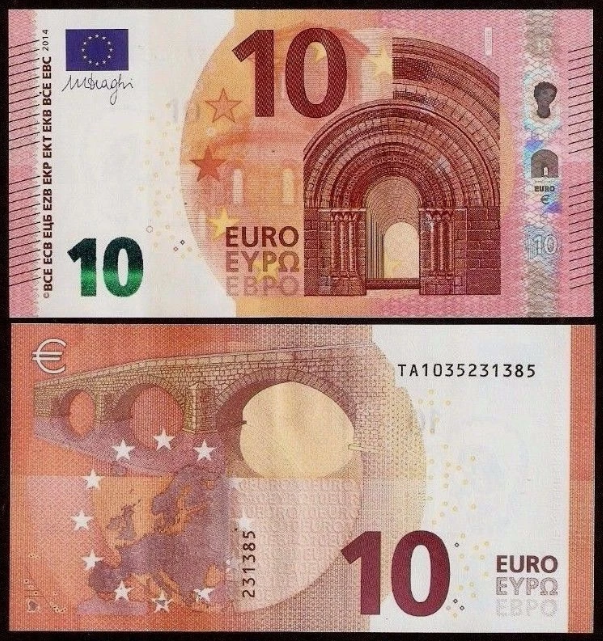
The Euro banknotes are unique because they do not depict real people or landmarks. Instead, their design reflects architectural styles from different periods of European history. Each note features:

  • Windows and Gateways (Front Side): Symbolize openness and cooperation within Europe.

  • Bridges (Reverse Side): Represent communication and unity between European nations and the rest of the world.

  • EU Flag and ECB Initials: Found in multiple EU languages.

  • Raised Print and Holograms: Enhance security and make notes easier to recognize.

The design was carefully chosen to represent a shared European identity, avoiding references to specific countries or leaders. Learn more on the official ECB banknote design page.


Security Features of Euro Banknotes

To combat counterfeiting, Euro banknotes include several advanced security features:

  • Watermarks visible when held up to light.

  • Holographic Strips or Patches that shift colors when tilted.

  • Raised Ink on the main image and lettering.

  • Security Threads running through the note.

  • Microprinting that is sharp and legible under magnification.

  • Ultraviolet Features visible under UV light.

More details can be found on the ECB’s guide to security features.


Euro Banknote Denominations in Circulation

Euro banknotes are issued in seven denominations, each with distinct colors and sizes for accessibility:

DenominationColorArchitectural StyleDescription
€5GreyClassicalRepresents architecture from Classical antiquity.
€10RedRomanesqueInspired by medieval Romanesque architecture.
€20BlueGothicFeatures Gothic-style windows and arches.
€50OrangeRenaissanceReflects Renaissance art and architecture.
€100GreenBaroque & RococoShows elaborate styles of the 17th and 18th centuries.
€200Yellow-BrownIron & GlassInspired by 19th-century industrial architecture.
€500 (no longer issued, but still legal tender)PurpleModern 20th CenturyRepresents modern architecture.

👉 Note: The €500 banknote was discontinued in 2019 due to concerns over misuse in illegal activities, but existing notes remain legal tender.

For a detailed breakdown, see Wikipedia: Euro Banknotes.


Importance of Design and Accessibility

The Euro’s design ensures:

  • Accessibility for visually impaired individuals, with different sizes and tactile features.

  • Cultural neutrality, avoiding favoring any single European nation.

  • Strong anti-counterfeiting measures, protecting the integrity of the Eurozone’s economy.


How to spot counterfeit Euro Banknotes
How to Spot Counterfeit Euro Banknotes

How to Identify Counterfeit Euro Banknotes

The Euro (€) is one of the most secure currencies in the world, featuring advanced anti-counterfeiting technologies. Still, counterfeit notes occasionally appear in circulation. Knowing how to verify banknotes helps protect you from fraud.

Below is a denomination-by-denomination breakdown, showing the security features and how to check them.


Security Features by Denomination

DenominationKey Security FeaturesHow to Spot Counterfeit
€5– Grey color, smallest size- Watermark portrait window- Raised ink on “EURO” and numerals- Security thread visible under light– Hold to light: check for watermark & thread- Feel the raised printing- Tilt: hologram stripe should change
€10– Red color- Watermark portrait window- Hologram stripe with architectural window- Microprinting visible under magnification– Check sharp details in microprinting- Tilt to see hologram image shift- UV light reveals security fibers
€20– Blue color- Complex hologram with gothic window design- Security thread across the note- Watermark portrait of Europa– Tilt to see hologram window colors shift- Hold to light: look for watermark & thread- Raised ink should be tactile
€50– Orange color- Large hologram patch showing number & window- Portrait watermark of Europa- Raised printing on numbers/text– Tilt: hologram number changes color- Hold to light for watermark clarity- Feel roughness of raised ink
€100– Green color- Hologram stripe with number & architectural arch- Emerald number changes from green to blue when tilted- Transparent portrait window– Tilt: emerald number color shifts- Check transparent portrait window of Europa- Microprinting should be crisp
€200– Yellow-brown color- Wider hologram stripe with satellite hologram- Emerald number with color shift- Transparent portrait window– Tilt: satellite hologram moves around number- Emerald number changes color- Feel raised print for authenticity
€500 (no longer issued but still legal tender)– Purple color- Large hologram patch- Watermark portrait window- Security thread visible under light– Tilt: hologram number shifts color- Check watermark under light- Feel raised ink for texture

General Tips for Checking Any Euro Note

  1. Feel: Authentic notes have raised ink and a firm polymer-cotton texture.

  2. Look: Hold the note to the light to reveal watermarks and security threads.

  3. Tilt: Holograms, numbers, and color-shifting elements should change smoothly.

  4. Use UV Light: Genuine notes glow with embedded fluorescent fibers and symbols.

For official guidance, see the European Central Bank’s security features page and Wikipedia: Euro Banknotes.

  • Sale!Counterfeit 100 Euro Banknote

    Buy counterfeit Euro €100 banknotes with all security features: Feature...

    $1,000.00 $2,400.00Price range: $1,000.00 through $2,400.00
    Rated 5.00 out of 5 based on 13 customer ratings
    • Select options This product has multiple variants. The options may be chosen on the product page
  • Sale!Counterfeit Euro 50 Banknote

    Buy €50 Euro Banknotes With all Security Features Present: Security...

    $1,000.00 $2,400.00Price range: $1,000.00 through $2,400.00
    Rated 5.00 out of 5 based on 8 customer ratings
    • Select options This product has multiple variants. The options may be chosen on the product page
  • Sale!Counterfeit Euro 20 Banknote for Sale

    Purchase Euro €20 Banknotes with all Security Features (Europa Series)...

    $1,000.00 $2,400.00Price range: $1,000.00 through $2,400.00
    Rated 5.00 out of 5 based on 16 customer ratings
    • Select options This product has multiple variants. The options may be chosen on the product page
  • Sale!Counterfeit Euro 10 Bills for Sale

    Buy Counterfeit €10 Euro Banknotes with all Security Features: Security...

    $1,000.00 $2,400.00Price range: $1,000.00 through $2,400.00
    Rated 4.92 out of 5 based on 13 customer ratings
    • Select options This product has multiple variants. The options may be chosen on the product page

The ECB’s Anti-Counterfeit Efforts and How to Report  Euro Banknotes

The Euro (€) is one of the most widely used and trusted currencies in the world, circulating across 20 European Union countries. To maintain this trust, the European Central Bank (ECB) works tirelessly to deter, detect, and combat counterfeiting. Despite advanced security features, counterfeit notes still appear in circulation. This is why both strong preventive measures and public awareness are essential.

This article explores the ECB’s anti-counterfeit efforts and provides step-by-step guidance on how to report counterfeit euros if you come across them.


The ECB’s Anti-Counterfeit Efforts

The European Central Bank, together with the national central banks of the Eurosystem, is at the forefront of protecting the integrity of the Euro. Its efforts include:

1. Advanced Banknote Design

  • The Euro banknotes are designed with multiple layers of security features, including watermarks, holograms, raised ink, color-shifting inks, microprinting, and ultraviolet elements.

  • The Europa series of banknotes, introduced in 2013, included even stronger features, such as the emerald number and portrait hologram of Europa, making counterfeiting much more difficult.
    Learn more at the ECB’s security features page.

2. Continuous Monitoring and Analysis

  • The ECB closely monitors counterfeit trends across Europe.

  • Twice a year, it publishes reports on the number of counterfeit notes withdrawn from circulation, keeping the public informed.
    See updates on ECB counterfeit statistics.

3. Collaboration with Law Enforcement

  • The ECB works with Europol, Interpol, and national police authorities to investigate and dismantle counterfeit networks.

  • Specialized training is also provided to banks, cash handlers, and retailers on how to spot counterfeit notes.

4. Public Education Campaigns

  • The ECB promotes awareness through guides, posters, and digital tools to help citizens easily verify banknotes.

  • The simple rule “Feel, Look, Tilt” is encouraged as a universal way to check Euros.


Steps to Report Counterfeit Euro Banknotes

If you suspect you have received a fake Euro banknote, it’s crucial to act responsibly. Here’s what to do:

1. Do Not Return the Note to the Person Who Gave It

  • Handing it back allows the suspect to reuse it elsewhere.

  • Politely decline if you notice before accepting.

2. Handle the Note Carefully

  • Place it in an envelope or plastic sleeve.

  • Avoid folding, tearing, or marking the note, as it may be used as evidence.

3. Contact Your Local Police or Bank

  • Report the suspicious banknote immediately to local police authorities.

  • Alternatively, you can take it to a bank branch, where it will be forwarded to the national central bank for verification.

4. Provide Details

  • Record where, when, and from whom you received the note.

  • If possible, provide additional observations about the transaction.

5. Await Official Verification

  • If the note is genuine, it will be returned to you.

  • If counterfeit, it will be confiscated, and you may not receive compensation (since counterfeit money has no value).

More guidance available at ECB: What to Do with Suspected Counterfeit Notes.


Why Reporting Matters

By reporting counterfeit euros, you help:

  • Protect businesses from financial loss.

  • Prevent criminals from reusing fake notes.

  • Support law enforcement in tracking counterfeit networks.

  • Maintain public confidence in the Euro currency.