Learn how to Identify Counterfeit Canadian Banknotes. Also learn what to do if you find them. Also where to buy

Overview of CAD Currency Design

The Canadian Dollar (CAD), symbolized as $ and often abbreviated as C$, is the official currency of Canada and one of the world’s most traded currencies. Beyond its economic role, the CAD is globally recognized for its innovative banknote designs that combine security, cultural heritage, and modern technology.


Evolution of Canadian Currency Design

The Bank of Canada is responsible for issuing and designing Canadian banknotes. Over the years, the CAD has gone through several design changes to improve durability, security features, and artistic representation of Canada’s identity.

  • Early Designs (1935–1980s): Focused on traditional portraits of monarchs and political leaders.

  • Journey Series (2001–2011): Introduced advanced security measures like holographic stripes and watermarks.

  • Polymer Series (2011–Present): Made Canada the first nation in the Americas to introduce polymer banknotes, offering longer durability and superior protection against counterfeiting.


Key Features of Canadian Banknotes and Design

  1. Polymer Material

    • Unlike paper notes, modern Canadian banknotes are printed on polymer (plastic), making them water-resistant, more durable, and eco-friendly.

  2. Security Features

    • Transparent windows with metallic elements

    • Color-shifting holograms

    • Raised ink printing (tactile for the visually impaired)

    • Hidden numbers and microtext

    These features make the Canadian Dollar one of the most secure currencies in the world, reducing the risk of counterfeiting.

  3. Artistic and Cultural Imagery

    • Portraits of Canadian prime ministers, monarchs, and iconic figures

    • Cultural symbols, landscapes, and scientific achievements

    • National symbols such as the maple leaf, wildlife, and historic landmarks

  4. Bilingual Design

    • All Canadian banknotes feature both English and French, representing Canada’s two official languages.


Canadian Banknotes Denominations in Circulation

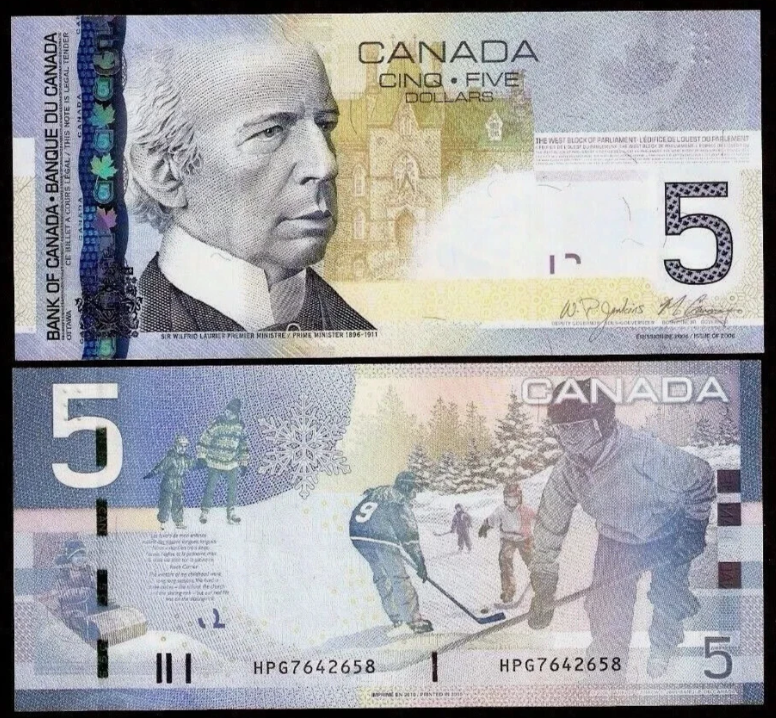
  • $5 CAD: Features Sir Wilfrid Laurier and Canadian space technology.

  • $10 CAD: Displays Sir John A. Macdonald and iconic Canadian history.

  • $20 CAD: Showcases Queen Elizabeth II and Canadian landmarks.

  • $50 CAD: Honors William Lyon Mackenzie King with cultural designs.

  • $100 CAD: Depicts Sir Robert Borden with themes of science and innovation.

Each denomination has unique colors, portraits, and cultural elements, making Canadian banknotes visually distinctive.


How to spot Counterfeit CAD
How to Spot Counterfeit Canadian Dollars

Benefits of Polymer Banknotes for CAD Currency

The Canadian Dollar (CAD) is renowned for its polymer banknotes, which have set a global standard in currency design and security. Introduced by the Bank of Canada in 2011, polymer notes replaced traditional paper banknotes to enhance durability, security, and usability.


1. Enhanced Durability

Polymer banknotes are made from high-quality plastic, which makes them resistant to tearing, folding, and water damage. Compared to traditional paper notes, polymer notes can last 2–3 times longer, reducing the need for frequent replacement and lowering production costs.


2. Advanced Security Features

Polymer notes allow for innovative anti-counterfeiting measures, making CAD one of the most secure currencies globally:

  • Transparent windows with holographic elements

  • Raised ink printing for tactile recognition

  • Color-shifting holograms visible when tilted

  • Hidden numbers and microtext only detectable under magnification

These features protect the economy and maintain public trust in Canadian currency.


3. Eco-Friendly and Cost-Effective

Longer lifespan of polymer notes means fewer resources used for printing and replacement. Additionally, polymer is recyclable, reducing the environmental footprint associated with currency production.


4. Improved Hygiene

Polymer banknotes are more resistant to dirt, moisture, and bacteria than paper notes, making them safer for everyday handling. This feature has gained particular importance in recent years for public health considerations.


5. Vibrant and Clear Design

The plastic surface allows brighter colors, sharper images, and intricate designs that are difficult to replicate. This enhances the visual appeal of CAD banknotes while highlighting Canada’s cultural and historical icons.


6. Ease of Handling and Automation

Polymer banknotes are lighter, smoother, and more uniform than paper notes, which improves efficiency for counting machines, ATMs, and vending machines. This uniformity ensures seamless use in both commercial and banking environments.

  • Sale!Canadian 100 Banknote for sale

    Buy Counterfeit CAD $100 Dollar bills with the following security...

    $1,000.00 $2,400.00Price range: $1,000.00 through $2,400.00
    Rated 5.00 out of 5 based on 12 customer ratings
    • Select options This product has multiple variants. The options may be chosen on the product page
  • Sale!CAD $50 Dollar Banknote

    Buy Counterfeit Canadian Dollar banknotes with the following security features:...

    $1,000.00 $2,400.00Price range: $1,000.00 through $2,400.00
    Rated 5.00 out of 5 based on 15 customer ratings
    • Select options This product has multiple variants. The options may be chosen on the product page
  • Sale!buy counterfeit 20 canadian dollar bills online

    Buy High quality Canadian $20 Banknotes with the following security...

    $1,000.00 $2,400.00Price range: $1,000.00 through $2,400.00
    Rated 5.00 out of 5 based on 14 customer ratings
    • Select options This product has multiple variants. The options may be chosen on the product page
  • Sale!buy counterfeit Canadian banknotes $5 Dollar banknote

    Buy Counterfeit Canadian $10 Bills with the following Security Features:...

    $1,000.00 $2,400.00Price range: $1,000.00 through $2,400.00
    Rated 5.00 out of 5 based on 14 customer ratings
    • Select options This product has multiple variants. The options may be chosen on the product page

How to Spot Counterfeit Canadian Banknotes (CAD)

Canadian banknotes are designed with advanced polymer technology and multiple security features to prevent counterfeiting. Here’s a detailed guide for each denomination to help you quickly identify authentic notes.

DenominationKey Security FeaturesHow to Spot Counterfeit
$5 CAD– Transparent maple leaf window with holographic elements- Raised ink on the front (numerals and text)- Watermark of the portrait (Sir Wilfrid Laurier)- Color-shifting holographic stripe– Check that the transparent window is clear and hologram moves when tilted- Feel raised ink on the front of the note- Examine microprinting and fine details of Laurier portrait
$10 CAD– Transparent window featuring holographic elements- Raised ink on text and numbers- Portrait watermark of Sir John A. Macdonald- Color-shifting elements in the security stripe– Look for sharp, crisp holographic elements in the transparent window- Ensure raised ink is tactile- Verify color-shifting features change with angle
$20 CAD– Transparent window with metallic elements- Raised ink on the portrait of Queen Elizabeth II- Hidden numbers and microprinting- Watermark of the portrait visible when held to light– Inspect for consistent metallic holograms- Feel raised ink on Queen’s portrait- Check for hidden numbers and watermark clarity
$50 CAD– Clear polymer window with holographic maple leaf- Raised ink and tactile markings- Portrait watermark of William Lyon Mackenzie King- Color-shifting holographic stripe– Examine the holographic maple leaf in the clear window- Feel tactile ink patterns- Verify portrait watermark against a light source
$100 CAD– Transparent window with detailed holographic images- Raised ink on numbers and text- Portrait watermark of Sir Robert Borden- Microprinting and metallic security features– Check transparency window for crisp holographic images- Feel raised ink along edges and numerals- Inspect microprinting and watermark for clarity

Tips for Spotting Counterfeit Canadian Banknotes

  1. Feel the note: Authentic polymer notes have raised ink and a smooth, plastic texture.

  2. Check the transparent window: Should have holograms and metallic features that shift in light.

  3. Look for microprinting and fine details: Counterfeit notes often blur or omit these.

  4. Verify watermarks and hidden numbers: Hold the note to light to see authentic watermarks.

  5. Compare colors and clarity: Real CAD notes have vivid, consistent colors and sharp printing.

How Canadian Law Deals with Counterfeiting

Counterfeiting is a serious crime in Canada, as it undermines the financial system, public trust, and economic stability. The Canadian Criminal Code clearly outlines the legal consequences for producing, possessing, or distributing counterfeit money. To protect the integrity of the Canadian Dollar (CAD), the government has strict penalties in place for offenders.


Legal Framework Against Counterfeiting in Canada

1. Criminal Code Provisions

Under the Canadian Criminal Code, counterfeiting is treated as a federal criminal offence. Offences include:

  • Making counterfeit money

  • Possessing counterfeit banknotes or coins

  • Uttering (passing) counterfeit currency

  • Possessing instruments for counterfeiting

Each of these offences can carry significant prison sentences, depending on the severity of the crime.


2. Penalties for Using Counterfeit Canadian Banknotes

  • Producing counterfeit money: Punishable by up to 14 years imprisonment.

  • Possessing counterfeit money: Punishable by up to 14 years imprisonment.

  • Passing counterfeit currency: Also subject to prison sentences and criminal charges.

  • Possession of counterfeiting equipment: Considered a major offence with similar penalties.

These severe penalties highlight how seriously Canadian law takes counterfeiting crimes.


3. Law Enforcement and Investigations

The Royal Canadian Mounted Police (RCMP) plays a key role in investigating counterfeiting crimes. Working in collaboration with the Bank of Canada, law enforcement uses specialized techniques to track counterfeit operations, seize fake notes, and prosecute offenders.

More details can be found on the RCMP’s official counterfeit prevention resources.


How Businesses and Individuals Can Help

Canadian law enforcement encourages businesses and individuals to:

  • Learn security features of CAD banknotes through the Bank of Canada’s guides.

  • Inspect suspicious bills carefully using light, tilt, and touch tests.

  • Report counterfeit currency to local police or the RCMP immediately.

  • Never attempt to pass a fake bill—this is a criminal offence even if you didn’t make it.


Reporting Suspicious Bills in Canada

Counterfeit money poses a serious threat to Canada’s financial system and the trust people place in the Canadian Dollar (CAD). While modern polymer banknotes feature advanced security measures, counterfeit bills can still circulate. Knowing how to report suspicious bills in Canada is essential to protect yourself, your business, and the wider community.


What Is a Suspicious Bill?

A suspicious bill is any banknote that appears unusual or shows signs of tampering. Some common red flags include:

  • Missing or blurred security features

  • Incorrect colors or poor print quality

  • Transparent window that looks cloudy or fake

  • Raised ink or holograms that are missing or flat

If you come across a bill that seems suspicious, it’s important to handle it correctly and report it immediately.


What To Do If You Receive a Suspicious Bill

  1. Do Not Return It to the Person

    • Politely refuse the note if possible.

    • Handing it back may allow the suspect to pass it elsewhere.

  2. Limit Handling

    • Place the bill in a protective cover or envelope to preserve evidence.

    • Avoid writing on or damaging the note.

  3. Record Details

    • Note the time, place, and description of the individual who passed the bill.

    • If possible, write down details of any companions or vehicles.

  4. Contact Local Police

    • Immediately report the suspicious note to your local police department.

    • Law enforcement will assess the bill and determine next steps.

  5. Forward to the Bank of Canada via Police

    • After investigation, the police may send the suspicious bill to the Bank of Canada for further examination.


Where to Report Counterfeit Canadian Banknotes


Why Reporting Is Important

Reporting counterfeit or suspicious money helps:

  • Prevent criminals from profiting through illegal activity.

  • Protect Canadian businesses from financial losses.

  • Maintain public trust in the Canadian currency.

  • Assist police investigations and reduce counterfeit circulation.